


Traditional asset management was never reliable. For decades, the business world had to deal with multiple spreadsheets, manual data entry and calendar reminders to manage the asset lifecycle. However, after all that manual effort on tracking your business assets manually, during operation hours, these equipment and machinery breakdowns happen without any notice. This is because manual asset management is reactive in nature.
This sudden breakdown of machinery and equipment caused severe operational and financial challenges.
Complete operational halt – Critical machinery and equipment breakdown in a construction site is a nightmare for any project manager. This brings the entire operation to a halt.
Delaying and postponing of projects – In continuous flow manufacturing, one machinery or equipment downtime stops the entire crew from moving to the next procedure of the project. Especially automotive assembly line manufacturing plants, where vehicles pass through specific phases one by one; if one critical piece of machinery or equipment stops in the process, the entire sequence gets delayed or postponed.
Emergency Repair Cost – In commercial facilities and property management industries, compliance is a number one priority. Having a broken Heating, Ventilation and Air Conditioning system means facing immediate safety hazards. This will then need to be fixed by paying a premium price.
Shortened Asset Lifespans – Due to continuously running machinery and equipment, the lifespan of each asset decreases. This increases purchasing rounds and decreases profit margins, downgrading the entire business from a competitive one to a surviving business
How to prevent machinery and equipment from breaking down during crucial operation hours.
To prevent machinery and equipment downtime, businesses must switch from traditional asset management systems to modern asset management systems. This system digitises the asset lifecycle, calculates maintenance schedules autonomously and reminds teams to act before failure occurs. This proactive nature can act as a closed loop system with five crucial phases.
Here’s how it works
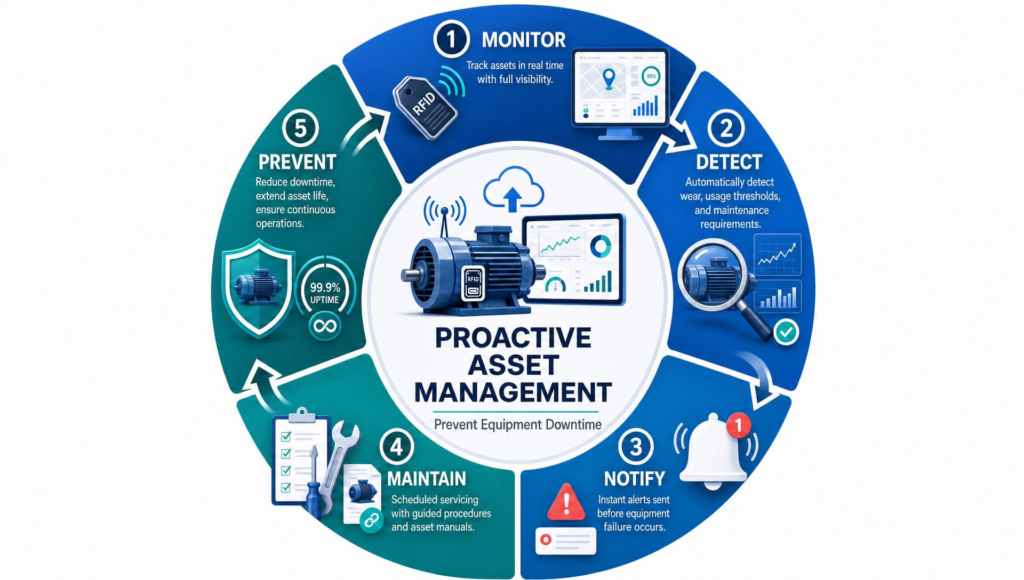
Monitor – Real-time tracking and visibility
Modern asset management systems eliminate manual logbooks using hardware to cloud data ingestion. Once machinery and equipment are tagged using RFID, cloud platforms can continuously extract location, operational status and real-time utilisation history without requiring repetitive manual data entry from time to time. This provides centralised visibility for all assets, making it easier for operational managers to make upcoming project decisions by choosing what machinery or equipment should be bought, repaired or removed from the project entirely.
Detect – Automated scheduling
Through an algorithmic rule-based engine, modern asset management calculates the raw usage of equipment and machinery, allowing the software to determine how much wear and tear each piece of equipment has gone through. This makes upcoming maintenance windows visible, making it easier to detect what machinery should be sent for maintenance before usage.
Notify – Proactive alerts
This is what allows the modern asset management systems to stand out from traditional asset management systems. When equipment or machinery surpasses its necessary usage threshold or maintenance time, the software alerts managers before the machinery is allocated to other operations. Rather than relying on human intuition or communication through traditional asset management systems, this can precisely notify managers, bringing the matter to their notice.
Maintain – View maintenance guidelines through linking assets to their documents
By abiding to alerts and notifications, managers can send equipment for maintenance at the right time. Moreover, in the maintenance phase, if the current repair technician doesn’t understand the necessary maintenance procedure for a highly specialised tool, modern asset management software takes care of it using the asset linking feature. This feature attaches relevant documents of the specific tool, so whenever it’s sent for maintenance, the repair technician can view the manual and guidelines to repair the tool.
Prevent – Zero downtime
The last phase of this closed looped system is the continued utilisation of equipment in any project without worrying about downtime. When implemented, modern asset management systems can keep critical equipment ready for operation continuously. By conducting necessary maintenance for machinery and equipment, businesses can increase asset lifespans, continue operation without the fear of equipment downtime, and save money on costly last-minute repairs.
Legacy Asset Management Vs Modern Asset Management
| FEATURE | LEGACY MANUAL SYSTEMS | MODERN ASSET MANAGEMENT |
| Data ingestion | Manually input data | Automated RFID tracking and IOT sensors |
| Visibility scope | The data is scattered across multiple spreadsheets or papers | Connect all data into one centralized dashboard. |
| Maintenance model | Reactive – Employees know the status of the equipment after the breakdown. | Proactive – Managers get alerts before equipment breakdown |
| Downtime risk | High | Near-zero |
Planning your next project?
Planning a project with reactive asset management is a fool’s errand. It exposes enterprises to operational vulnerabilities, unpredictable project overhead and missed delivery deadlines. Transitioning to a proactive asset management eliminates equipment downtime and allows continued operation. Moreover, this gives stakeholder confidence in the operation from the beginning to the very end. To discover how “your business’ can eliminate equipment downtime and extend equipment lifespan, contact us!
FAQ
How does RFID technology improve asset tracking accuracy over traditional methods?
Traditional asset tracking relies on manual barcode scans or paper clipboards, which leads to lost items and data entry lag. Moreover, traditional asset tracking needs human oversight, counting assets one by one and recording them, which leads to errors eventually. RFID tags automatically transmit asset identities and locations to the cloud when they pass readers, giving managers instant, error-free visibility across multiple sites simultaneously.
Can modern asset management software integrate with our existing enterprise asset frameworks?
Yes, modern asset management software’s features modern API architecture built to ingest data from legacy ERP databases and external supply chain infrastructure. This lets your business centralise operational data streams into a single dashboard without tearing out your existing business systems.
How does the notification system work in modern asset management?
When the equipment passes the threshold of usage, the automated system sends alerts and notifies relevant managers regarding the equipment and schedule maintenance windows so technical employees can conduct maintenance or send it to a repair technician.
When sending specialised equipment to maintenance, can you attach documents and guidelines with the equipment?
Through its asset linking feature, any document regarding the equipment can be sent to relevant parties. For example, if it’s a unique equipment and the repair technician doesn’t know how to conduct a proper service for it, the maintenance document can be attached to the equipment and sent directly to the repair technician.
